The Alternatives Foundation is the only nonprofit purpose-built to accept illiquid private equity, venture capital, and closely-held business interests—assets most charities cannot touch—and convert them into transformative funding for universities and research organizations nationwide.
"The assets sitting in private equity portfolios represent the largest untapped philanthropic frontier in the United States."
— The Alternatives FoundationMost charitable giving involves writing a check or wiring cash. TAF unlocks a fundamentally different category of giving—one that lets entrepreneurs, investors, and business owners contribute the wealth actually tied up in their portfolios, without waiting for a sale.
The donor transfers their PE fund interest, VC stake, LLC units, LP interest, or real asset to The Alternatives Foundation via a deed of gift. TAF receives the asset and becomes the legal holder, allowing the donor to claim a charitable deduction for fair market value at the time of contribution.
Unlike forced liquidations that destroy value, TAF's patient capital philosophy means we hold the asset until a natural exit occurs—a fund distribution, a business acquisition, a refinancing, or another liquidity event. This maximizes the value delivered to beneficiaries.
When liquidity occurs, TAF collects its 1.5% annual administrative fee and converts the remaining proceeds into charitable dollars. TAF's fee is collected only at this stage—never upfront—aligning our incentives directly with maximizing value to your chosen institution.
Philanthropic capital is distributed to the donor's designated beneficiary: a university endowment, a research fund, a scholarship program, or a major research nonprofit. TAF maintains relationships with partner institutions nationwide to ensure smooth and timely grant-making.
Donor-advised funds, community foundations, and university gift offices are not built to handle the legal complexity, long holding periods, or administrative burden of alternative assets. TAF was purpose-built for exactly this problem.
| Capability | TAF | DAF / CF | Univ. Gift Office |
|---|---|---|---|
| Accepts PE / VC fund interests | ✓ | ✗ | ✗ |
| Accepts closely-held business interests | ✓ | Rarely | ✗ |
| Patient liquidation philosophy | ✓ | ✗ | ✗ |
| No upfront fees to donor | ✓ | Varies | N/A |
| Multi-institution beneficiaries | ✓ | ✓ | ✗ |
| Dedicated alt-asset expertise | ✓ | ✗ | ✗ |
TAF's founding team brings deep VC and private equity backgrounds. We understand fund structures, LP agreements, carried interest mechanics, and the legal nuances of transferring fund interests to a nonprofit. We have built the legal infrastructure—including donor guarantee and indemnification frameworks—to handle assets that would overwhelm a standard gift office.
A forced or premature liquidation of an illiquid asset destroys value. TAF's singular advantage is our willingness and structure to hold assets over multi-year time horizons, waiting for the moment of maximum value. Our fee structure—1.5% annually, collected only at liquidation—ensures we have every incentive to wait for the best outcome.
Founded in Texas—the most entrepreneurially dense state in the United States—TAF has built its proof of concept with a growing network of university and research partners. Our national expansion brings the same patient, expert approach to alternative asset philanthropy to donors and institutions across the country.
TAF operates under Committo Group, LLC, which provides additional operational infrastructure including DAF management software already in production use. This technology backbone allows TAF to manage a growing portfolio of complex asset gifts with institutional-grade rigor and transparency.
Donating an appreciated alternative asset directly to TAF is structurally superior to selling the asset and donating the proceeds. The math is compelling for any donor holding appreciated PE, VC, or business interests.
See the Calculator →Donors receive a charitable deduction equal to the fair market value of the contributed asset at contribution—not cost basis. Subject to standard AGI limitations (typically 30% for capital gain property contributed to a public charity).
Because the transfer is a charitable contribution rather than a sale, the donor never triggers a capital gains event. This can save 20–37% of the embedded gain depending on asset type, holding period, and applicable rates.
By avoiding capital gains taxes, the full pre-tax value of the asset flows toward the charitable mission rather than to the IRS—creating a substantially larger gift than selling first and donating after-tax proceeds.
TAF enables donors to act before a liquidity event—locking in the charitable deduction at current FMV while the asset is still illiquid. Particularly powerful in a year with other large income events or when anticipating a pending sale.
TAF routes philanthropic capital to a growing network of partner institutions across two primary categories: educational institutions and research organizations. We work with development officers and gift planning teams to ensure seamless gift acceptance.
TAF works with university development offices and endowment managers to accept alternative asset gifts on behalf of individual institutions. Proceeds fund endowments, scholarships, named professorships, research centers, and capital projects.
Major research nonprofits—including organizations focused on cardiovascular disease, neurological conditions, and other health priorities—partner with TAF to receive alternative asset gifts that fund research programs their standard gift offices cannot accommodate directly.
Does your institution want to expand its gift acceptance to include alternative assets without building internal infrastructure? TAF serves as your operational partner—handling asset intake, legal documentation, stewardship, and distribution at no cost to the institution.
Alternative assets accepted by The Alternatives Foundation include: limited partnership interests in private equity funds; LP or LLC interests in venture capital funds; equity interests in closely-held operating companies (LLCs, S-corps via specialized structures, C-corps); limited partnership interests in real estate funds; and similar illiquid, non-publicly-traded investment interests.
Donor-advised funds primarily accept cash and publicly traded securities and typically decline complex or illiquid alternative assets due to valuation challenges, UBTI exposure, legal complexity, and multi-year holding requirements. TAF was specifically designed to address these barriers with the legal structure, team expertise, and fee model to accept and patiently hold such assets.
When a donor transfers a PE or VC fund interest to TAF, the donor may deduct the fair market value (not cost basis), subject to 30% of AGI for capital gain property contributed to a public charity, with a 5-year carryforward. No capital gains tax is triggered on the transfer—the fund interest's embedded appreciation is fully bypassed.
The Alternatives Foundation is a 501(c)(3) public charity (EIN: 87-3652885) administered by Committo Group, LLC. It was founded in Texas, initially as The Texas Alternatives Foundation, and rebranded to reflect national operations.
TAF charges a 1.5% annual administrative fee calculated on the value of assets under stewardship, collected at the time of liquidation—not upfront. This aligns TAF's incentives with maximizing impact: a longer, more patient hold that produces a higher philanthropic impact for the beneficiary institution.
TAF's patient capital philosophy refers to its willingness to hold illiquid alternative assets for as long as necessary to achieve a natural, value-maximizing liquidity event. Many organizations that attempt to accept alternative assets are forced to sell them quickly at significant discounts. TAF's legal structure, operational model, and fee structure are designed to support long holding periods for better beneficiary outcomes.

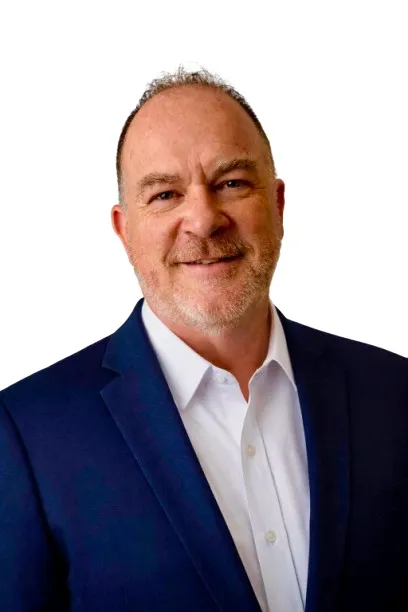
Serial entrepreneur and institution-builder with 25+ years founding and scaling companies across multiple states and in multiple industries — including two that earned multiple appearances on the LSU100. After an exit, he built LSU's Stephenson Entrepreneurship Institute into a self-sustaining entity, served as a mentor for the Entrepreneurship Bootcamp for Veterans with Disabilities, launched the Entrepreneurship Fellows Program, and worked closely with the Chancellor to identify new revenue opportunities. He's helped scale fast-growth companies nationally and globally, including impact-driven work in Australia. His advocacy for entrepreneurship on Capitol Hill earned personal recognition as "a catalyst for change" from President Obama.

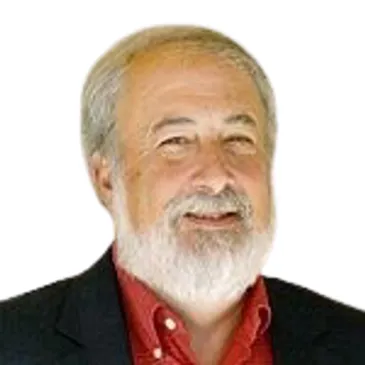
Physician-entrepreneur with 30+ years at the intersection of medicine, managed care, and technology. Former Chief of Pulmonary Medicine at Texas Tech, he founded Intercede Health in 1997—growing it from a three-person startup to a medical management company serving 1M+ patients—and co-founded HealthSpring, which IPO'd in 2006 and was acquired by Cigna for $3.8 billion in 2011. Founder of the Sanger Learning Center at UT Austin; current boards include Televero Health, Precedent Health, and Employer Direct.

Founder and Managing Director of G51 Capital Management, one of Texas's most active early-stage venture investors since 1996. Syndicated $300M+ alongside Bain Capital, Polaris, and Foundry Group, with portfolio companies acquired by Cisco, ADP, SAP, and Prudential. Founder of the G51 Amplify Venture Scholars Program across 13 graduate schools with 200+ alumni; former Chairman of the UT Alumni Association (100,000 members) and lifetime honorary trustee of Dell Children's Medical Center.

Managing Director and Wealth Partner at J.P. Morgan Wealth Management with 25+ years advising ultra-high-net-worth individuals, multi-generational Texas families, and C-suite executives on single-stock monetization and generational wealth transfer. Co-founder of SGH Group; founding member of J.P. Morgan's Houston office. Began his career at the U.S. Treasury Office of Tax Policy and the George H.W. Bush White House. Named FT 400 Top Financial Adviser; ranked among Barron's America's Top 1,000 Advisors.

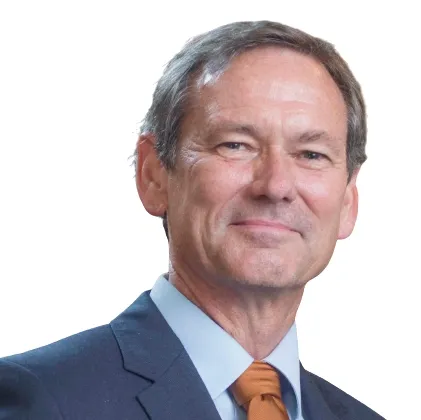
Retired banking executive with 35+ years of Texas financial leadership, including 17 years as Austin Market President of Texas Capital Bank—the institution's second Austin employee. Named 2025 Austinite of the Year; served as Interim CEO of the Greater Austin Chamber of Commerce in 2023. Former chair of Opportunity Austin and the Austin American Heart Association; appointed to Texas One by Governor Rick Perry. Current board member, Susser Bank and Texas Business Hall of Fame.

Distinguished Teaching Professor of Chemistry and Biology at UT Austin, where he served nine years as Dean of Undergraduate Studies. Researcher in molecular systems, vaccine and therapeutic design, and materials science; co-author of the leading Organic Chemistry textbook (9th edition, Cengage). Board member of the Research Corporation for Science Advancement and Kesem, which supports children of cancer patients across 130 campus chapters nationwide.

Austin native with a 30+ year career spanning commercial banking, venture capital, and executive leadership. Rose from Texas Commerce Bank to EVP and President at First Interstate Bank–North Austin, then served as COO of a venture-backed firm, led a marketing company to a Fortune 1000 acquisition, and executed a turnaround resulting in a Fortune 500 division sale. Former Vice Chair of the Greater Austin Chamber, United Way co-chair, and 18-year board member of the Star of Texas Rodeo (President, 1994). BBA and MBA, UT Austin.

Founding Partner and former Chief Investment Officer of Alliance Residential Company, one of the nation's largest multifamily developers, with a career spanning 40+ years and 100,000+ units. Previously served as President and COO of Gables Residential following its 1994 IPO; earlier led south Texas operations for Trammell Crow Residential. Began his career as a CPA at Kenneth Leventhal & Company (now Ernst & Young). BBA, UT Austin.

CEO of AngelSpan and a 30+ year veteran of investment management and early-stage finance. Founded Legacy Capital Management in 1993, growing AUM from $35M to $200M while serving high-net-worth clients alongside firms like Sequoia Capital and Silicon Valley Bank at 3000 Sand Hill Road. Subsequently founded Angel Legacy LLC, one of the earliest angel-entrepreneur matching platforms. Recognized as a leading authority on angel investor psychology, portfolio management, and alternative market structure.

Entrepreneur and investor who has founded and exited three companies across CPG, SaaS, and MedTech. Manages the venture portfolio at Greenwood & Cavalier and advises family offices on private-market strategy. Creator of SteadiSpoon, a patented assistive device featured on Fox News, NBC, and The Dallas Morning News. National Academy of Engineering Grand Challenges Scholar, Coca-Cola Scholar, and Texas Business Hall of Fame Future Business Legend.
Whether you're a donor exploring a gift of PE interests or business equity, a wealth advisor working with a client, or an institution looking to expand gift acceptance—our team is ready to walk you through the process.